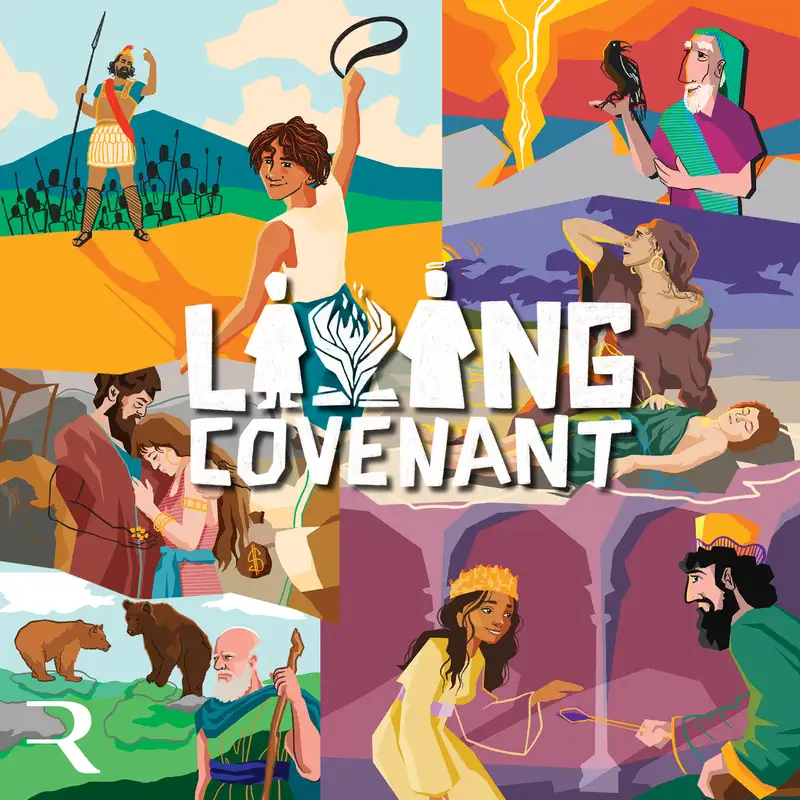
Saul: The crown and the silence
Welcome to the Living Covenant Podcast, where we journey through the messy human stories of the Old Testament explore what it means to live in covenant with a promise keeping God. I'm your host, Zanita. Let's dive in.
Hello everybody and welcome back to the Living Covenant Podcast. I am here today with Blake Penland. Blake and I actually went on a Bible lands trip just before 📍 COVID to Europe and the Middle East, and I just really loved hearing his perspective and his view on 📍 things while we were over there. He's written an article for us in this series called The Crown and the Silence. On the life of Saul. So welcome to the show Blake. It is great to have you on.
appreciate it. Yeah, no I'm excited to be here and happy to contribute and hopefully give some insight that is useful to people. And that's kind of my goal this year. I always try to pick something every year and my goal this year was to be useful, so what I'm trying to do.
Love that.
Yeah. Cool. Well, before we get into the life of Saul, do you wanna give the audience a little bit of insight into the life of Blake?
Yeah, sure. So I've done a lot of different things in my life for a living. I've been a lumberjack, I have been a teacher, I've been a support worker. I was a pastor actually for 15 years as well too. So eight years volunteer, and then seven years as a full-time paid pastor and I planted a church, which was really cool and I love that. I was a director of operations for a physical therapy business. And then now I am a counselor as well too. So I've done quite an eclectic mix of different things. Uh, did I say I was a primary teacher as well too? I think I threw that in there. But yeah, done a ton of different things.
But I am currently now working, I have a business, it's called Beyond Exodus, where I provide therapy, counseling, and a bit of coaching and mentoring as well too. Probably my main area of focus is I help pastors and their families, ministry families, leaders of the church and pastors specifically and their families as well too, helping 'em through difficult times with dealing with maybe depression or grief recovery, or anxiety and general difficulties that we all deal with.
And then I help the general public as well too. I really focus on helping people who are recovering from divorce or separation. And I try to help them I call it the Divorce Recovery Blueprint, and I help them rebuild their lives after everything has fallen apart.
So I help people out. Um, it's pretty cool and I enjoy that. Uh, my family?
Yeah. So I'm married. My wife's from Brazil. Her name is G or Gianna is her name. It's spelled like Diana the Princess but in Portuguese, the di makes a G sound. So we just call her G for short. We lived with my daughter as well too. She is? Oh wow. She's 14 years old now. That's scary.
Actually. Let's, let's not say that again. Um, she's getting older, and take her to a lot of basketball games and love that. Mm-hmm. She's very very big up into basketball. And then my favorite food is pretty much anything. My wife cooks, honestly, like she's, she kind of spoiled me for going out to eat because her food is better than the restaurants.
It's kind ruined Brazilian food. I've ruined my life in some ways. Yeah, it's all Brazilian. Well, she does Italian and Brazilian, all sorts of stuff. But, in some ways I'm like, you've, you've ruined my restaurant experience because now I go like, yeah, this isn't really as good as when you make it. Yeah.
So she makes the best risotto. It's like mind blowing. So anything she cooks.
They say you're a good cook if you can make good risotto.
And she can. I would say that's a probably good test. 'cause it's like a 40 minute process. It's crazy. Mm. Yeah. All the love you gotta put into it, so.
Well, maybe we'll circle back to risotto later in 📍 the conversation, but I'd love to start talking about your piece. You wrote at the start of your article, there are some stories in scripture we turn to for inspiration and others we return to because they won't let us go. Now, I'm curious to know, was your reason for choosing to write about Saul born out of inspiration, or was it the latter, couldn't, couldn't let you go, kind of thing?
Yeah. Um. Saul is not one of my favorite characters in the Bible at all. Not even close, but it's probably all of the lessons that really hit home. It's like the lessons of what not to do. His life is an instruction manual on what not to do if you are given influence or power, or
any form of responsibility or leadership. It's like, go read the story of Saul to help you know, everything not to do. And we often talk about the Bible in a way that is like, uh, I, I like to use it as the basic instructions before leaving Earth, the B-I-D-L-E. But we kind of disregard or throw away sometimes all the instruction manual that is what not to do, right? So we read the story of Joseph and like, yeah, we wanna be like him or David, like, yeah, I'm gonna kill this giant, it's gonna be super awesome and we wanna destroy the giants in our lives that hurt us. You know, but no one really talks about, let's talk about Saul because there are some really, really powerful lessons to learn from his life on what not to do, when we're put in that situation.
And, and pretty insightful mental health insights as well too.
Hmm. Can you unpack that? For those people who haven't really explored, Saul's story in much depth, can you give us like a overview of what his story entails?
Yeah. He was a big guy, so I relate to that as well too. He was head and shoulders above everybody else, and then he was on a mission to go get his father's donkeys and, you know. Wound up being king of the entire nation. So not many people can say that like, ah, I was out searching for donkeys and I came home as a king. Uh, and so, the people had basically rebelled against God's plan of having prophets as leaders who were kind of conduits to the spiritual realm and through basically to God.
And they were like, no, we want to be like everyone else. We want a king and God. Basically told the prophets like, Hey, you don't actually want this because here's all the bad things that are gonna happen. They're like, we love that idea. Give us the king. That's a great idea. And God's like, okay, if that's what you want, I'll do it, but I don't think you're gonna like it.
And Saul is the first king of Israel, and he is anointed and chosen by God. But when he becomes the king things don't play out in the way that everyone had hoped for. I believe so. He was very successful. He killed like thousands of people actually in terms of like from a warrior perspective. 'cause back then being a king was a lot of war.
So he was really good at that. But he seemed to struggle over and over and over with doing the right thing or doing what was best by doing something that was good, at least in his eyes. And so oftentimes good can be the enemy of best, and he struggles with that throughout his entire life.
Then he gets jealous of David, who is going to be the next king chosen by God because. You know, humans are jealous, and that's a big part of it. And then he starts losing his mind a little bit when he is throwing spears at David and trying to kill him and hunts him down for most of his life. And finally, very sadly, the end of his story is going to this seance or at the witch of indoor to call up the prophet who had previously been involved in his life and he had passed away, he calls him up from the dead, even though it's not him. But he calls up an evil spirit that is representing him and he is told that he's gonna be killed and his son's gonna be killed the next day in a battle. And then he loses his life by taking his own life,
uh,
because the guy who is serving him refuses to listen to the command of the king. 'cause he tells him, kill me 'cause I don't wanna be killed by my enemy. And he's like, I won't do it. And so he actually ends up committing suicide, which is a really, really sad ending of that story when he had so much promise. Now that's a very short version.
Yeah.
Over many, many, many years. But I think the theme of that is struggling to fulfill his calling. Hmm. That God had placed on his life in pursuit of his own personal comfort or desires. And that I think is a very relevant story for us in today's age. And with everything that we have available, like we have been given this calling that God has placed upon our lives, and yet we run away from that for ease and comfort and anxiety.
Hmm.
We don't wanna deal with it all.
Yeah. Yeah. It's not like a lot of the other Bible characters, I suppose, where something happens and there's this big turnaround moment.
And you keep thinking it's gonna happen, right? You keep thinking like, "This is it." And then now it's getting worse, like, "Wow, wow, it's worse and worse and worse," and just gets w- and then it ends in him taking his own life. And I think that's actually a lesson in and of itself, things don't just get better unless you make real changes.
If you just keep thinking it's gonna get better, you... Go read the story of Saul and you go, "Oh, it, it actually doesn't get better if you don't turn back to God, if you don't make the decision to say, 'Not my way, but your way, Lord. Not my will, but your will be done.'"
Mm-hmm.
Talk to us more about that because you mentioned there's some lessons about mental health in here and I feel like sometimes people don't always know when to act and when to just step back and pray about it and let God do his thing. I feel like there's this confusion as to, or do I just trust and pray that God is going to miraculously change my circumstances or by taking things into my own hands, am I not trusting him? Am I not surrendering to him? You know, I feel like, there's all these questions and there's not super clear answers as to what our posture should be in certain situations.
biblical answer for that would be yes. uh, to both. Because we have the example well, when we go back to Moses and the Israelites, you're gonna, and so Saul is the king of Israel, and so we have to look at his history as well too.
Moses, they don't, through God's power, they part the Red Sea and they walk through on dry ground, very clear direction. Like that's the way walkie in it, right? Then later on when they cross the Jordan, the priests actually step out into the flowing water, and it's not until they're in the water doing the thing that the water stops, then the path is made clear and everyone crosses.
And so it's important for us to recognize, like there are times that we wait and there are times that we need to act both of those times, they're intentional. Like they're intentional times. They're either like, okay, Lord, I don't know the direction, so I'm going to intentionally wait for your guidance in this, and I'm gonna prayerfully request your guidance and your decision making and hopefully you'll make it clear what I need to do, what my next steps need to be.
The other one is, I'm intentionally, Lord, I'm gonna go this direction. I'm gonna walk out into the water and if this is the path I'm gonna keep going. If not, stop me and bring me back. Right? But both of those are intentionality. And so whenever you're thinking. You know, I don't know what to do, and you're on the fence and you're kind of being lukewarm about a situation.
Well, that's not intentional, right? And that's when you can really know, okay, well this is clearly not the direction that I need to be going because I'm kind of floating along and I'm not intentionally going or intentionally waiting. And so whatever you do, don't do nothing expecting that there is incredible changes on the horizon. Be intentional about waiting or intentional about going forward. Or sometimes you need to step back as well too, but whatever it is, be intentional about it. And I think that helps us to make better decisions when we're making decisions and not waiting for decisions to be made.
Because by waiting, like deciding to wait. Is actually, that's a good decision 'cause you're like, I am choosing to wait for your leadership and guidance. Mm-hmm. But that's different than just doing nothing and not being intentional about the situation. So for me, I would say yeah, be intentional with your actions or your inactions and invite God to be a part of that process.
Yeah, I think that's really helpful. I think also sometimes people act or they don't act, they're passive or they take things into their own control because of things they believe about themselves as well. So we see Saul, for example, when we read his story, we get the impression that he thought of himself as small or insignificant or unworthy. And out of that comes certain actions. So how can we start to become aware of the lies that we are living by and that we are believing, that are dictating our actions, whether we realize it or not.
Oh, that's a beautiful question. Uh, talk about it . The best way to expose a lie is to go and tell it to your friends and to your family or maybe to some professional counseling or therapy, and go, this is what I'm feeling, this is what I'm thinking, and I wanna get this out in kind of the ether into the, into the world. And I want to talk about it because I want to ask, is this accurate? Or is this inaccurate? And I want to know, and I want some time to reflect personally, and I want some other perspective on this as well too. It's so easy to believe a lie in a vacuum. It's very difficult, for the truth of a matter to be hidden when exposure comes. So like when the light comes and hits, the truth is revealed. But when you're living a lie or when you are hiding something, or, believing something that you are not really exposing the light to or being authentic with yourself or with others. That's where that can metastasize. So that's where inaccuracy and self-loathing and lies metastasize and grow inside of our minds when we're not actually authentically sharing that and communicating that with the people around us as 📍 well too.
Which not always easy. It's kind of difficult sometimes.
It's difficult. Yeah. I did this experiment once where I asked people, what do you see in me that you don't think I realized about me? And it, it's not a pleasant experience 'cause you're like, oh no man. People, people see that or they think that
but if you're ready for it, it's a
Well, you might not be ready for it, but that level of vulnerability and authenticity with yourself and with others. You will not remain stagnant. You will not remain frozen in your journey or in your experience like you will be forced. When you're that vulnerable, you'll be forced to make a decision for better or for worse to change. Right? And that's what we see. Saul not doing. He refuses to be vulnerable. So when the prophet Samuel comes to talk to him and, and goes, what have you done? Why are you, who's the king acting like a prophet when you're not supposed to be?
And he is like, ah, it's not really my fault. Okay. The people are kind of crazy and like they needed a little bit of guidance and like you were in a way, man, you were a long, I'm like, where were you? Huh? Like, what, where were you supposed to be? I'm doing your job. Actually, you know, you should be fired.
It's just like goes down this path of like ridiculousness because he's not being vulnerable. He's not taking responsibility for himself, and he's blaming everyone but himself for his problems. It's David's fault, right? If I throw a spear at him. And kill 'em. Pin 'em to the wall. Maybe all my problems will be solved, right?
But very rarely is that the case, you know? Mm-hmm. So actually, I want to go on the record. Throwing a spear at someone to pin them to the wall is never the answer. So if you don't get anything else from this podcast, remember Don't spear people.
Mm. I don't wanna, I don't wanna take sides with Saul, but part of me does feel for him, and not just for Saul, but I think, I feel for people in leadership positions and pastors because, for me, it's not so difficult to like confess my wrong doings to a friend.
Oh. Or to be exposed because you know what? What audience do I have? But if I had a following of, I don't know, a hundred thousand people, or if I was a pastor of a church and everyone was looking up to me and admiring me, I think I would find it really difficult to be honest about the struggles in my life.
Not just because I don't want people to know, but I think because, with that comes, you know, potentially for some people that's like a loss of job or potentially that's a loss of a role or a loss of respect.
This is something I'd be curious to hear about from you, because I know that you've been in leadership positions, you've been a pastor, you've been a teacher, and you have been in that position where people have been looking up to you. Have you found yourself in Saul's position where you're like, oh, it's actually really hard to do that ?
No. Super easy. Never had any struggles with that. It is just like really easy to be a leader. Yeah. Moving on. No, uh, in all seriousness, heavy is the head that wears the crown, right? So it's very easy. I like to use this a little bit of a redneck wisdom. Uh, I, I grew in a trailer and a log cabin. And my family is a very colorful background for sure.
But my dad used to have a saying, he said, everyone knows how to deal with a kicking cow except for the owner of the kicking cow. So it's super easy to be like. And if I was a pastor, I would never do that. Oh, he should do this as the pastor. What an idiot. Oh, he's terrible at doing this. Like, you have no idea all of the strings being pulled, all of the struggles, all the burdens of a leader of anything. A church especially, but of anything. Right. And the more reach and influence and impact that you have, the heavier the burden. Like I, I can't imagine how difficult would it would be to be the Prime Minister of Australia or worse, the President of America.
Oh, that's like, nothing you could ever do would be correct. Whether you're a Democrat or Republican or labor or liberal, it doesn't matter because you are always gonna be wrong to someone. Right. And so being in that leadership role, you have to find people that you can confide in so you don't have to go and be vulnerable and authentic to the whole world all the time because there's a time and a place for everything. But finding someone and this could be professional help as well too, and probably would recommend this as well. You know, in biblical times we'd call those advisors and maybe now we would call them counselors or psychologists or therapists, right?
And so having people that we can go and break down all the stuff that's going on in our head and say, this is what I'm feeling, this is what I'm thinking, give me some feedback on this. Help me to process this. And ultimately you have the decision as the leader to, to do whatever you need to do for your life and for the lives of those that you lead.
But having advisors and wise words, people who are not just yes men or yes women, but people who are gonna give you honest feedback. It helps you be a better version of yourself and a better leader as well too . and it is really easy to point fingers at bad leadership, but just remember you have multiple fingers pointing back at you when you point a finger at someone, right?
So every time you point the finger at someone, you have to be very willing to accept the criticism that is being returned back towards you. And that's not always fun or easy to think about, but just before you criticize, if you're gonna go criticize, go criticize 'em to their face as well too rather than telling everyone around them how terrible they are without telling them, because that is the literal spirit of Lucifer when you go and tell everyone else how bad that person is without having a conversation one-on-one with them, like you do not want that in your life. Mm-hmm.
And
if you find yourself doing that, you need to check yourself and go, I should probably stop doing that. Or if that's being done to you, which is the case when we look at Saul and David, like Saul is literally jealous and angry and pointing all the fingers it's all David's fault, not looking at himself. Later on, David does a terrible thing with a young woman. He ends up killing her husband and has a baby with her and ends up marrying her, and then the prophet comes in and says, this is a terrible thing that you've done.
And when the prophet comes and tell a different prophet, that's the Nathan prophet. When Samuel comes and tells Saul, this is a terrible thing that you've done right. Saul blames everybody but himself when Nathan comes and says, this is a terrible thing that you've done. And it was both those things are bad things.
I would even say David's thing was probably even crazier and worse. David goes, you're right, that was wrong and I repent and I'm gonna ask God for forgiveness. And he still paid the consequences. But that's the different approach. Like if you can get honest feedback. What you do with that feedback really reveals the character that you have.
Hmm. Yeah. I think it says a lot about someone as well who does do something wrong, but then instead of like cowering and shame and running away, owns up to that and shows up. Because I think that's probably the tempting thing to do is just be like, oh, everyone's found out. I'm outta here 'cause I can't handle this.
I really think guilt and shame, like just what you're talking about. I want to point this out, I think guilt is a good thing from God, and I think shame is a bad thing from Satan, and so guilt is like, Hey, you have done some pretty terrible things. And you need to change your ways. And guilt is like, I should, I'm gonna repent and I'm gonna change my ways.
That's guilt. Shame is you are a pretty terrible person. You are terrible. And then the shame says, I am a terrible per. I'm terrible. I'm the worst. I'm pathetic. I'm awful, I'm stupid. Right? That shame talking. It's not useful. Right? You can't do anything with that. You're like, yep, I'm the worst. And that's it. And then you just move forward with your head down. You don't move anywhere. Sometimes you become stagnant, right? And so shame is totally useless, and when other people use shame to you, that's bad as well too. But guilt helps us to realize you are not the problem. Your behavior is inaccurate. Change your behavior where shame is like saying you are the issue. And there's nothing you can do. You're just a loser. When you hear that voice from others or from yourself, you need to go to God and say, that doesn't sound like guilt. That sounds like shame. Please help me to reframe that. Please help me to understand where that's coming from and help me to move forward with you as the focus Lord, like that's the difference between guilt and shame.
That's a really good distinction. For anyone who is trying to navigate that or trying to reframe those narratives do you have any helpful tips that you've given perhaps to clients or in your counseling practice?
For sure. You need to ask yourself every time you're feeling, if you're feeling anything. First off, all emotions are valid. So every emotion that we have as human beings totally valid.
Now, validity of an emotion doesn't mean it's true. It's just means it's a valid emotion, like that's coming from somewhere. So then you gotta go and ask yourself, okay, I, I'm a loser, right? So that's what you're thinking, ah, I'm a loser. Okay. Automatically, it's a shame based statement because it's not about behavior, it's about identity, right?
So you're saying that I am a loser, is shameful kind of connotations and thought process. So every time you feel these feelings, you even think to yourself, is this about my behavior or is this about my identity? And when it's about identity, you need to ask yourself, what about my behavior is making me feel like a loser?
And then you can turn that into, a guilt phrase and you can go, oh, I'm a loser because I am behaving in a way that makes other people not be around me because I'm being mean or angry or terrible. And those behaviors, right, are the things that I can change. But you can't just go and flip a switch and change your identity.
So that's why you have to think to yourself, how did I get to this shame statement. Well, it's probably based on some sort of guilt from somewhere. And now I need to go and analyze. And that's where going to a therapist is really useful and go, this is what I'm feeling. How can we transfer this to a guilt statement instead of a shame statement?
Hmm.
It's,
it's super useful. 'cause I have that all the time. Like, oh man, I'm, I'm stupid, I'm a loser. I'm no good. I think that all the time, like it's actually almost a daily event. And then I'm like, hold on. That's a shame statement. I go, why am I saying this? And I think to myself, oh, maybe 'cause I did this or did that.
Okay, let's work on that behavior. Like a good example would be like. Uh, I'm a fat slob. Like, so you say that about yourself, like, okay, why are you saying that? Well, I didn't do any exercise today, right? So let's reverse that shame statement of being a fat slob and saying, well, I didn't exercise today, so now I'm going to go and exercise. See how much healthier that is. It's just like a complete transition from an unhealthy perspective to a healthy one.
And even you and I, you know, we were talking about this before we pressed record on this episode, but you and I are both doing our masters of counseling at the moment and we've both seen various counsels in our lives and even we have to constantly be checking those lies in our heads and constantly 📍 be reframing them.
all the time. no shame in that either. In fact, there's no shame. No, and, and I think it's important to remember that like that's called being a human Welcome to the club. If you have negative perceptions of yourself, like welcome, welcome to authenticity and being, and if you have only positive perceptions of yourself, you should also go and see a therapist immediately.
Yeah.
Because if you don't have a realistic view of who you are, that's a whole other version of issues as well too. So both, both sides, like it's very useful to have a realistic perspective of who you are, but to differentiate that from shame and guilt and go, is this about who I am?
Which really the only true answer to that is you are a child of God. You have infinite value and worth because of that. And then your behaviors are not who you are. That's just things that you do or that you don't do. And those can be changed and that's the difference between guilt and shame and the story of Saul really helps us to see basically unbridled shame leads to the end of Saul's life because he can never acknowledge he needs to change his behaviors. He can never acknowledge his own responsibility. He is always passing the buck onto someone else. And in doing that, never being vulnerable, never acknowledging his own guilt, never really making changes. It ends in spiritual death and in Saul's case, his literal death as well too.
Yeah, it's not a good ending, is it? Obviously we don't see a huge turnaround in his story, like it ends with him giving up his life. But I wanna pivot to something that you touched on briefly in your article. You wrote towards the end. But even as Saul wrestles with these forces, we still see God's compassion. God is not in a hurry to replace Saul. He tries to soothe him and bring healing through music before judgment. He sends music.
In a minute we'll get to what this story shows us about the character of God. But first, I would love to know why you chose to highlight and talk about music. Like obviously God shows up and moves in all sorts of different ways for different people, but has music been something that has been cathartic or healing in your own journey? And if so, what has it been about? Music that has helped? 'cause I think a lot of people can probably relate to that. You know, we listen to sad songs when we are sad because we feel seen and we feel less alone and so 📍 on. But just speak to us about what music has been for you in your own journey.
So probably my most useful therapy sessions that I have is me, my guitar, and God. And I will write songs that I pour out my heart to God. Some of my songs I cannot sing in public. They're very inappropriate, but they're useful for my own therapy, because I'm being vulnerable and I'm being honest and authentic with God, and I'm singing about these issues. And the music has been such a healing factor in my life. I have really painful songs. And I've got happy songs as well too, about feeling good as well too.
But, I mean, I, I don't even, I've probably written like 200 songs in my life, I don't even know, but, and some of them will never be sung ever again because they were just needed for that moment, in that time in my life to process that emotion in a way that I believe would
not have been possible otherwise.
So for me, the music and creating music and I feel like it's not just the music, but I feel like it's the creative aspect because we are created in the image of God and God is a creator. So anytime we partake in creative behavior, we are connecting with our creator in a way that is otherwise, you know, not possible or relevant.
And when we talk about anxiety, just a sidestep here. There's this thing called the anxiety death spiral, where you just, you hop on board and you just go down and down and down and it gets worse and everything. And like, oh, that's gonna happen and this, and logically speaking, like, well, if that happens, then this is gonna happen and that's gonna happen and this is gonna happen.
And then, oh no, and then this is gonna happen. And, oh no, I know that's gonna happen. You're just. You spiral out of control. Right? The way to sever this, there's been some really cool research on this recently, is to activate the other hemisphere. Now I'm dyslexic, so it's not gonna be useful to say left or right, but whatever. One, the logic side is not on the other side, the creative side. Your anxiety is just having a heyday in your logical hemisphere. Like, just like, yeah, let's rock and roll. We're gonna take over. Like, oh, this is awesome. And then on the other hemisphere. Which is the creative side. This has nothing to do with the logical side, and so when we activate the creative side, we are severing the anxiety death spiral.
So some really good examples to do this, you can look up some different things, but one of 'em would be pick up a pen. If you're stressing out with anxiety, and with your offhand, so I'm right-handed. So pick up a pin with your left hand. Write your name with your left hand. Write your name backwards with your left hand.
Write your name, uh, from the top to the bottom with your left hand, from the bottom to the top, right upside down. So you're create, you're activating the creative aspect of your mind. Now for me. Anything creative. So watercolor, painting, creative writing of a novel or a fantasy book if you wanna write that. Or a nonfictional book, like getting creative, doing some drawing or for me songwriting. what that does is it literally cuts off and stops the anxiety death spiral so that you can actually live again. Without being a slave to the spiral, you actually get to live and you're living because you're opening that door for the creator to come into your life with this creative aspect of your life. So you're cutting off that anxiety death spiral in the logical side of your brain, and you are opening that creativity for the other side of your brain. Then you're using your whole brain. And your allows you to alleviate that anxiety. It's pretty cool. That's why the music for me is so powerful because it's literally my creative endeavor to anxiety.
I feel like I need to sit here and soak that in. 📍
for me, I think more than the music is the creative aspect of the music, right? So for me that's where that really means a lot personally.
But I mean, you can be creative. That's another example actually, like creative dance, right? So if I ever am dancing, I. This could be a shame statement, but I'm a bad dancer. Um, and I don't think a lot of people are gonna wanna watch me dance and I'm not really. A dancer. I don't have much of a dancer's body.
I've been blessed with a lot of body, but not a dancer's body. And, but for me, the music of creating the music, that's the thing that helps. But for someone else, they could, it could be interpretive dance and they could hear the music and get creative and that could help their anxiety. I could totally see that being a very real thing that is useful and helpful.
Yeah. Yeah, I can relate to that for sure. Well, we have, touched a lot on the life of Saul here, and I think obviously these Old Testament characters can teach us what to do, what not to do in this case, probably. But, yeah. In reading about Saul's story, did you have any revelations about God ?
Yeah, so the biggest revelation was God's patience. God crowned Saul and Saul was literally behaving inappropriately for like 40 years, maybe even more. 42 maybe. I don't know exactly the exact number, but many, many years of complete inappropriate behavior. And that's a guilt statement 'cause we don't wanna shame him, but very inappropriate behavior and yet God never gave up on him. And in fact, in the end of the story, even though Saul commits suicide, which is terrible, it's not God giving up on Saul. It's Saul giving up on himself. And I think that was the biggest revelation in that story is like if you have breath in your lungs. Blood in your veins. If you have synapses firing in your mind, you still have an opportunity to follow the Lord and you still have an opportunity to right the wrongs that you're responsible for and to live a life that is worth living and worth sharing with others, and that was powerful for me.
I still have time in my life. That's the good news. And, and so do you, and so does everyone
God will never give up on you. But that doesn't mean save that for 30 years down the road because you saw for sure how terrible Saul's life was and his mental health and all of his issues.
You can, you can stop all that right now, buddy. Getting back with God and following him. The only difference between a righteous person and an unrighteous person is getting back up. 'cause a righteous man, he falls seven times and he stands up again. Right?
it's not like righteous people do more righteous things is just when they mess up, they get back up again.
And that's the difference. So like. I'm not very good at it, but I want to be righteous. So when I fall, and I do often, and I'm guilty of many, many things, I don't wanna stay fallen. I want to confess my sins. I want to talk to God, and that I want to acknowledge my guilty behavior, and I wanna ask for both repentance and the ability to be better moving forward.
And no matter how I fall and whatever way that I fall. I don't wanna stay fallen. I want to get back up and I want to like crawl and claw my way back into a healthy relationship with God. And if that's every minute of every day, that's still better than staying fallen.
hundred percent. Well, Blake, I feel like this conversation has been very useful, so you're definitely leaning into your motto for the year.
Excellent. But excellent. No, in all seriousness, thank you so much for your transparency and your insights. For anyone who would like to read the full story, you can check it out in the Living Covenant book. It's called The Crown and the Silence. Thank you again, Blake
yeah, no worries. Thanks for having me. Really enjoyed it.